Vehicle Battery Finder
Why Wait in Traffic? Enter Your Details & Reserve
Your Battery in Under a Minute.
Got 60 Seconds? Tell Us Your Vehicle &
Secure Your Battery Delivery Today.
Is Your Car Dead? Take 60 Seconds to
Secure Same-Day Delivery.
Want to Schedule a future delivery with us?
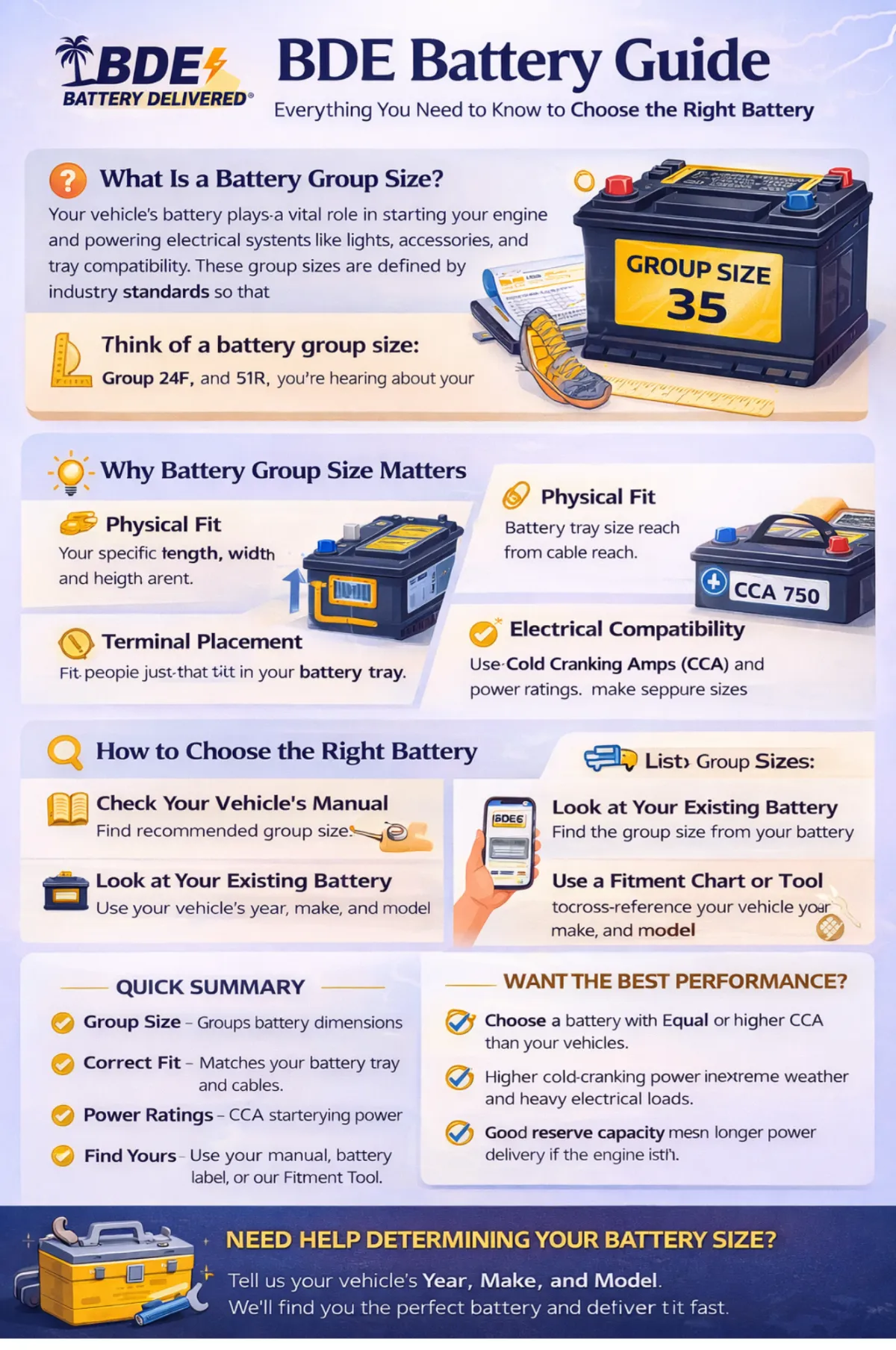
BDE Battery Guide
Everything You Need to Know to Choose the Right Battery Your vehicle’s battery plays a vital role in starting your engine and powering electrical systems like lights, accessories, and onboard electronics. Knowing how batteries are sized and matched to vehicles helps you pick one that fits right and performs reliably.
📏 What Is a Battery Group Size?
When you hear terms like Group 24F, Group 35, or 51R, you’re hearing about the battery’s group size — a standardized way to describe its physical dimensions, terminal layout, and tray compatibility. These group sizes are defined by industry standards so that replacement batteries fit correctly and connect properly to your vehicle’s electrical system. Think of a battery group size like a shoe size: the right one ensures a secure, stable fit, whereas the wrong size might not sit correctly or align with your vehicle’s connectors.
⚙️ Why Battery Group Size Matters
🧰 Physical Fit
Each group size corresponds to a specific combination of length, width, and height. A battery that’s too large may not fit in your battery tray, and one that’s too small won’t secure firmly, which could lead to movement and damage over time.
🔌 Terminal Placement
Group sizes also determine where the positive (+) and negative (–) terminals are located. This matters because incorrect terminal placement can mean your cables won’t reach or may connect incorrectly.
⚡ Electrical Compatibility
Although size is about physical fit, you also need a battery with adequate power and starting performance for your engine. This includes ratings like Cold Cranking Amps (CCA) and Reserve Capacity (RC) — but those are separate from group size.
🛠 How to Choose the Right Battery
1. Check Your Vehicle’s Manual
Your owner’s manual typically lists the recommended group size for your specific make and model. This is the best starting point.
2. Look at Your Existing Battery
You can also find the group size printed on the battery itself. Matching this number ensures a good fit.
3. Use a Fitment Chart or Tool
Battery fitment tools — like the one we use at Battery Delivery Express — help cross-reference your vehicle year, make, and model with the correct group size. That way, you get a proper match every time.
🧾 Common Automotive Battery Group Sizes
Different vehicles use different group sizes depending on battery tray size and power needs. Here are a few examples:
Group 24/24F – Common on many sedans and light trucks
- Group 35 – Popular on many Japanese imports and compact vehicles
- Group 51R – Often found on smaller cars
- Group 65 – Larger batteries for full-size trucks and SUVs
- Group 48 (H6) – Common on European and newer vehicles
- Group 94R (H7) – Used on higher-performance and luxury models
Every group size has specific dimensions and terminal layouts, ensuring the battery fits securely and connects properly to your vehicle’s electrical system.
🧠 Want the Best Performance?
Even within the same group size:
- Choose a battery with equal or higher CCA than your vehicle originally had.
- Higher cold-cranking power helps in extreme weather and heavy electrical loads.
- Good reserve capacity means longer power delivery if the engine isn’t running.
Battery Delivery Express tests and selects batteries that not only fit your vehicle but also deliver reliable performance every time.
📍 Quick Summary
🔹 Group Size – Standard indicator of battery dimensions and terminal layout.
🔹 Correct Fit – Ensures physical and electrical compatibility.
🔹 Power Ratings – CCA and RC tell you how well the battery will start your engine and hold charge.
🔹 How to Find Yours – Use your manual, existing battery label, or our fitment tool.
🧰 Need Help Determining Your Battery Size?
At Battery Delivery Express, we make it simple. Tell us your vehicle’s year, make, and model — we’ll match you with the right battery and deliver it fast. Visit our Find My Battery page to get started.
Fast Car Battery Delivery & Installation Services In Southern California


Our Services
Choose A Battery
Installation
Extended Warranty
© 2026 Battery Delivery Express. All Rights Reserved. Your local roadside power partners.